Put Down the App and Follow Your Nose: The Hungry Traveler's Guide to Eating Like You Actually Live There
The Review Problem Nobody Wants to Admit
Travel review platforms have a dirty secret: they're most useful for the places that least need your help finding them. The restaurant with 4,000 five-star reviews and a 45-minute wait is already doing fine. What they can't show you is the tamale cart that's been operating on the same corner in San Antonio for nineteen years, or the Vietnamese family that runs a lunch counter out of their garage in Houston every Friday, or the Hmong grandmother in Minneapolis whose egg rolls have a three-block reputation and zero online presence.
Those places exist in every city, in every small town, along every stretch of highway in America. And the only way to find them is to stop looking at your phone and start paying attention to the world around you.
This is food-based serendipity — and once you learn to do it, you'll never eat the same way on a trip again.
The Traffic Method: Follow the People, Not the Stars
Here's a field-tested technique that works in cities, small towns, and everywhere in between: watch where people actually eat at peak meal times.
Not where the menus look good. Not where the sign is attractive. Where are people — specifically, people who look like they live here — actively eating and enjoying themselves at noon on a Tuesday or 7 p.m. on a Thursday?
Dan Kowalski, a travel writer and self-described "professional lunch finder" from Chicago, uses this method everywhere he goes. "I give myself thirty minutes before I'll commit to eating anywhere," he says. "I just walk. I look for tables that are occupied, for to-go bags being carried out, for a line that's clearly made up of people in work clothes who have forty-five minutes and know exactly where they're going. That line is always worth following."
The logic is simple: locals don't have time to waste on bad food. If they're eating somewhere on a weekday, it's because that place has earned their trust.
The Smell Factor
This sounds too basic to be useful, but it is genuinely one of the most reliable tools in the serendipitous eater's kit: follow good smells.
Wood smoke in the morning means someone's starting a barbecue pit. Frying oil and onions at 10 a.m. means a breakfast spot that starts early. Fresh bread smell means a bakery, possibly unmarked, possibly incredible. Cumin and chile means something worth investigating in any American city with a significant Latino community.
Kate Sullivan, a solo traveler from Portland, Oregon, found her favorite meal of a three-week Southwest road trip this way. "I was driving through a small town in New Mexico, windows down, and I smelled green chile roasting. I pulled over immediately. There was a woman with a roadside setup — no sign, just a folding table, a propane burner, and a cooler. She sold me two pounds of fresh-roasted Hatch chiles and pointed me toward her cousin's restaurant two blocks away. Best posole I've ever had. I would have driven right past both of them."
Ask the Right People
Not all local knowledge is created equal. Here's a rough hierarchy of who to ask when you want an honest food recommendation:
Taxi and rideshare drivers — This is the classic for a reason. They eat out constantly, they know every neighborhood, and they've driven enough tourists to understand exactly what you mean when you say you don't want "the touristy place." Be specific: ask where they eat lunch, not where they'd send a visitor.
Gas station and convenience store clerks — Underrated. These people know the town at every hour of the day. They hear about every good and bad meal. Ask who makes the best breakfast in town and watch their face light up.
Hotel housekeeping staff — Not the concierge (who often has relationships with restaurants), but the people cleaning the rooms. They're local, they're not incentivized to send you anywhere specific, and they usually have strong opinions.
The person eating alone at the counter — If someone is eating alone at the counter of a diner or lunch counter, they're a regular. They're there because they love it. Ask them what to order. They will be delighted you asked.
The Unmarked Door Principle
Here's a counterintuitive truth that experienced food travelers learn quickly: the less effort a restaurant puts into its exterior presentation, the more likely it is that the food is doing all the work.
This isn't a universal law, but it's reliable enough to be worth acting on. The hand-lettered sign on cardboard. The screen door with no handle. The strip mall spot wedged between a nail salon and a tax preparer. The truck that's been parked in the same lot so long it's become part of the landscape.
These places don't need to look appealing because their reputation is entirely word-of-mouth. They're not trying to attract passersby — they're serving the people who already know.
Trevor and Alicia Nguyen, a couple from Atlanta who've made a habit of "unmarked door dining" across the South and Midwest, describe a discovery in rural Mississippi. "We saw a cinder block building with a hand-painted sign that just said FISH. One word. We stopped. It was a family operation — the father fried catfish, the daughter made hush puppies and coleslaw, and the grandmother sat in a lawn chair by the door. There were eight picnic tables, all full. We waited twenty minutes and it was the best fried fish we've ever eaten. That place will never be on any app."
How to Do This Safely and Respectfully
Food serendipity works best when you approach it with curiosity and humility, not the entitled attitude of someone looking for content.
A few practical notes:
Check for basic food safety signals — A clean operation, food kept at appropriate temperatures, staff who handle food properly. These things matter regardless of how humble the setup.
Be a grateful guest, not a documentarian — Ask before photographing anyone's food or operation. Many family-run spots don't want the attention; they're not looking to go viral. Respect that.
Spend generously — If a taco costs $2.50, don't negotiate. Tip well at spots that accept tips. Buy something extra. These businesses run on thin margins.
Learn a few words if there's a language component — "What do you recommend?" in Spanish, Vietnamese, or whatever language is most relevant to where you are goes an extraordinarily long way.
The 24-Hour Menu in Practice
Here's what a full day of eating-by-instinct can look like:
Breakfast: Skip the hotel continental spread. Walk two blocks in any direction and find the diner with trucks parked outside.
Mid-morning: Follow the coffee smell. The independent cafe you find will be better than any chain.
Lunch: Ask your rideshare driver on the way to your first stop. Go wherever they say without looking it up first.
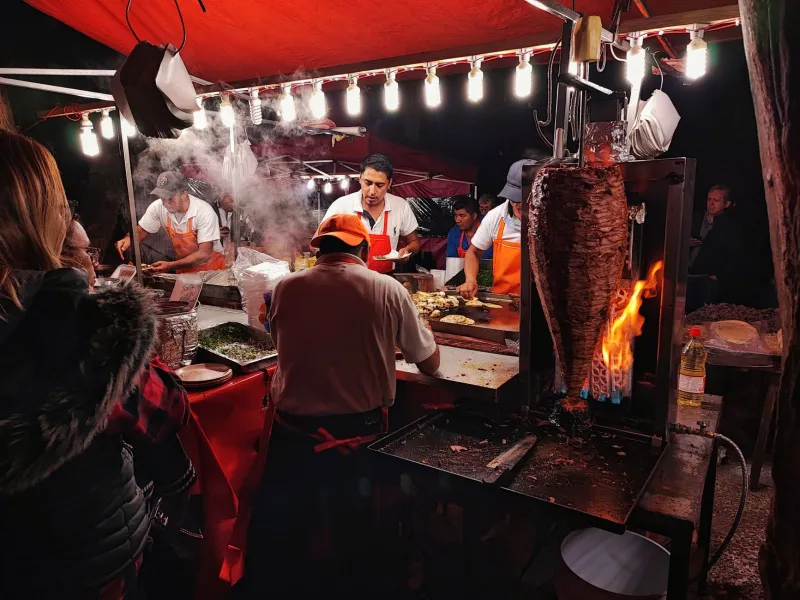
Afternoon snack: Follow the cart or the truck. Street food in America is having a genuine moment and the best of it isn't on any app.
Dinner: Walk the neighborhood you're in. Look for full tables and occupied stools. Go in. Ask what's good. Trust the answer.
The food you find this way will be imperfect sometimes. Occasionally you'll end up somewhere mediocre. But you'll also end up at the tamale cart, the fish shack, the family kitchen that feeds the neighborhood — and those meals will stay with you long after the perfectly-reviewed restaurants have faded from memory.