The Best Directions Are the Ones You Never Needed
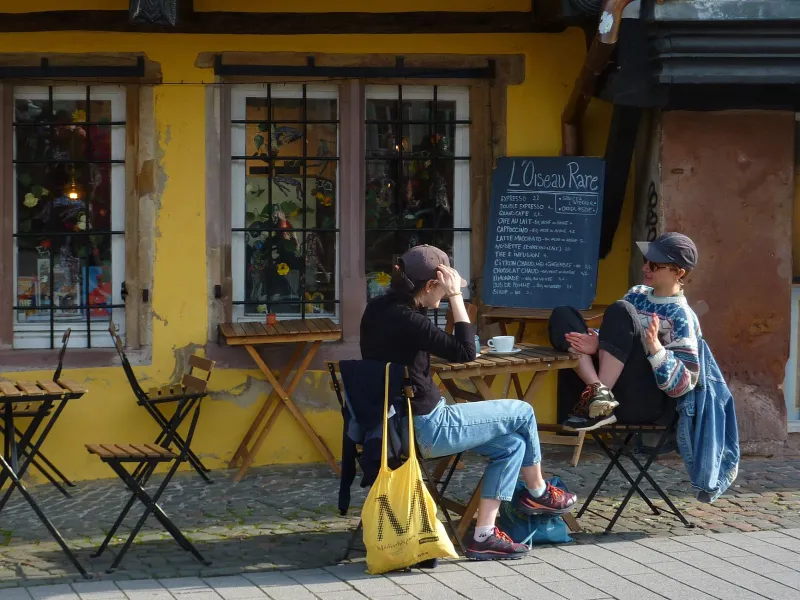
Let me tell you about a woman named Carla, who has traveled to forty-three states and keeps a journal of what she calls her "fake lost" moments. She has a system. When she arrives somewhere new, she finds a local business — a hardware store, a diner, a barbershop — and she walks in and asks for directions to something she already knows how to find.
Not because she's confused. Because she's figured out that asking for help is a door, and most travelers never think to open it.
"I'll ask how to get to the town square," she told me. "I already know where it is. But the person helping me doesn't know that, and by the time they're done explaining, we've been talking for ten minutes and I know three things that aren't on any map."
This is not a trick. It's a philosophy.
The Vulnerability Gap
Here's the thing about modern travel: we've engineered out almost all of our helplessness. GPS, Google Maps, review apps, translated menus — we arrive somewhere new fully armored against confusion. And that armor does exactly what armor always does. It keeps things out.
Helplessness, it turns out, is social currency. When you need something from someone, you create a moment of genuine human connection that no amount of confident navigation can replicate. You're not a tourist with a phone. You're a person who doesn't know where they are and needs another person to help them.
That's actually kind of rare and kind of wonderful.
The "fake lost" approach is just a way of manufacturing that moment deliberately. You're not being dishonest about who you are — you're being honest about what you want, which is a real conversation with a real person who knows this place better than you do.
What Happens When You Ask
Travel writer and longtime road-tripper Marcus, who has driven every US Route in the lower forty-eight, describes a moment in a small town in eastern Tennessee that changed how he thinks about asking for help.
He stopped at a gas station and asked the attendant — a man in his seventies named Earl — for directions to the nearest diner. Earl gave him directions. Then Earl paused. Then Earl said, "You know, if you want good food, I can tell you where my daughter-in-law works."
The restaurant Earl described wasn't on Yelp. It was a buffet in the back of a community center that ran on Friday and Saturday evenings, staffed by volunteers raising money for the local fire department. Marcus showed up, paid twelve dollars, ate the best green beans of his life, and ended up helping set up folding chairs for two hours while a man named Curtis taught him a card game he'd never heard of.
"None of that happens if I use Google Maps," Marcus said. "The GPS would have found me a diner. Earl found me a Friday night."
The Exact Phrasing That Works
There's an art to this, and the phrasing matters more than you'd think. Here's what actually opens doors versus what closes them.
Doesn't work: "What's a good restaurant around here?" — Too broad. Too tourist-coded. People give you the safe answer, which is usually the place that's already crowded with visitors.
Works better: "I'm trying to find somewhere to eat tonight — where would you go?" — This shifts the frame. You're not asking for a recommendation. You're asking them to imagine themselves in your shoes, which is a fundamentally different cognitive act.
Works even better: "I've been driving for a few hours and I have no idea where I am, honestly — is there anything in this town I absolutely shouldn't leave without doing?" — The admission of disorientation is key. It signals openness. It signals that you're not checking items off a list.
The Carla special: "Can you tell me how to get to [thing you already know]?" — Simple, effective, opens the conversation without any pressure.
What you're doing in all of these is signaling that you're available for a real answer, not a polished one.
The Barbershop Principle
If you want a masterclass in this technique, walk into a barbershop or a beauty salon and ask a question. Any question. These are spaces where conversation is the entire point — people go there partly to talk, and the people who work there are professional listeners and storytellers.
A question about directions or local recommendations in a barbershop will almost always cascade into something larger. You'll get opinions. You'll get history. You'll get the name of someone's cousin who does fishing tours. You'll get warned away from the one road that floods every spring.
Same principle applies to: hardware stores, bait shops, feed stores, small-town diners before 9 AM, and any establishment where a television is tuned to a local news channel.
Why This Feels Weird (And Why That Feeling Is the Point)
Most of us are trained, especially as adults, not to ask for help we don't need. It feels inefficient. It might feel a little dishonest. There's a voice in your head that says, you have a phone, just use it.
But that voice is optimizing for efficiency, and efficiency is the enemy of serendipity.
The friction of asking — the slight awkwardness of approaching a stranger, the vulnerability of admitting you need something — is exactly what makes the interaction real. People respond to genuine need, even manufactured genuine need, in ways they don't respond to a search query.
And here's the thing: you're not actually being deceptive. You genuinely don't know what that person knows. You genuinely don't know what they might offer. You're asking for directions, sure, but what you're really asking for is access — to their knowledge, their experience, their particular version of this place.
That's not a trick. That's just a conversation.
A Note on Reciprocity
The best version of this isn't one-directional. When someone helps you — really helps you, takes the time, tells you the good stuff — give them something back. Tell them where you're from. Tell them what you're looking for on this trip. Ask them something about their town that shows you were listening.
Carla, the woman with the forty-three-state journal, says the best conversations she's ever had while traveling started with fake directions and ended with her learning something she couldn't have googled in a thousand years. A family recipe. A local legend. The name of a stretch of river that doesn't have a trailhead sign but has the best swimming hole in three counties.
None of it was on the map. All of it was worth finding.
Sometimes the best way to find where you're going is to pretend, just for a moment, that you have absolutely no idea.