Ditch the Directions: The Surprisingly Rewarding Case for Getting Wonderfully Lost
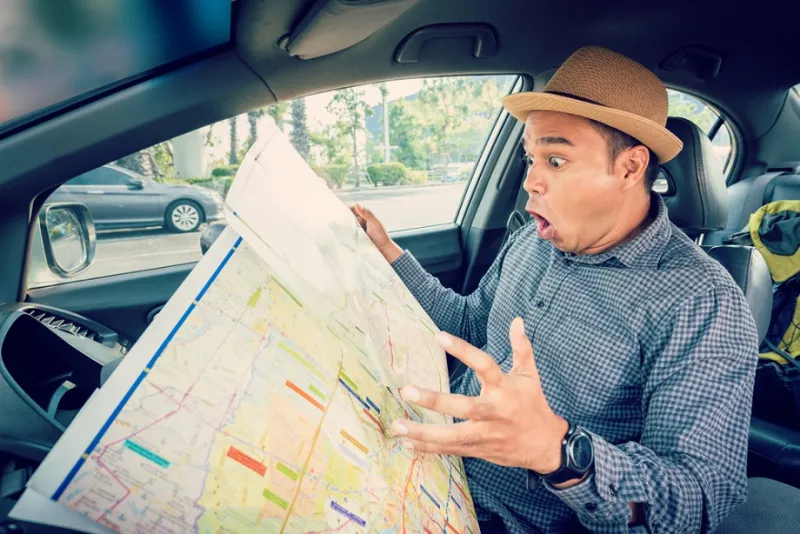
Photo: traveler reading paper road map on rural highway road trip USA, via driving-tests.org
Your Phone Doesn't Know About the Good Stuff
Let's be honest. Google Maps is incredible for getting somewhere on time. It is absolutely terrible at helping you find anything worth talking about later.
Think about your best travel memory. Really think. Chances are it didn't happen because an algorithm routed you there. It happened because you took a wrong exit, followed a hand-lettered sign, or asked a gas station attendant where they go on their day off. That's not an accident — that's serendipity doing its thing.
The whole premise behind wandering without a digital leash isn't about being reckless. It's about giving yourself permission to be surprised. And in a country as wildly varied as the United States, that surprise is basically guaranteed if you just loosen your grip on the screen.
Why Intentional Wandering Actually Works
There's a concept in travel psychology sometimes called "planned serendipity" — the idea that you can structure your trip loosely enough to allow unexpected discoveries while still giving yourself a general direction. It sounds contradictory, but it works beautifully in practice.
You're not driving blindfolded into the Nevada desert. You're heading roughly toward the coast, or vaguely northeast, with a few anchor points — a town you want to sleep in, a landmark you're curious about — and everything in between is fair game.
This approach works especially well on road trips across states like Montana, New Mexico, Kentucky, and the Carolinas, where the space between destinations is often more interesting than the destinations themselves. The highway tells you nothing. The back road tells you everything.
The Paper Map Revival Is Real (And Justified)
Here's something that might sound retro but is genuinely practical: buy a paper road atlas before your next trip. The classic Rand McNally Road Atlas costs about $15 and covers all 50 states. It will not give you turn-by-turn directions. It will, however, show you every county road, state forest, small town, and scenic byway that your navigation app quietly ignores.
Travelers who've made the switch consistently report the same thing — they start noticing names on the map that spark curiosity. Why is there a town in Oregon called Boring? What's actually in Intercourse, Pennsylvania? What does the road through the Ozarks look like compared to the interstate? The paper map invites questions. The GPS just gives you orders.
Jamie R., a road tripper from Austin who drove the southern half of the US last summer, described it this way: "I pulled off for gas in a tiny Alabama town and asked the woman behind the counter if there was anything worth seeing nearby. She looked at me like I'd asked the best question of her week. Twenty minutes later I was eating the most incredible fried catfish at a place with no sign, no Yelp page, and a porch full of locals who wanted to know my whole life story."
That is not a story that ends with "and then Google Maps took me there."
Talking to Strangers: The Original Search Engine
Asking locals for recommendations is a skill that atrophied the moment smartphones arrived, and it's worth deliberately rebuilding.
The key is specificity. Don't ask "what's good around here?" — that question is too broad and people freeze up. Instead try:
- "Where do you actually eat lunch on a workday?"
- "Is there a road around here that's worth driving just for the view?"
- "What's something most visitors completely miss?"
These questions signal that you're genuinely curious, not just looking for a Tripadvisor shortcut. And people respond to that. Hotel housekeeping staff, diner waitresses, park rangers, bait shop owners — these are your best navigational resources, and none of them require a data connection.
Marcus T., a photographer from Chicago who spent three weeks driving through Appalachia, credits a single conversation with a retired coal miner in eastern Kentucky for the best photographs of his career. "He told me about a hollow — that's what they call the valleys there — that had a one-room church from the 1800s still standing. No road signs pointing to it. Just his directions: 'turn left where the old Sinclair used to be, then follow the creek.' I found it. It was extraordinary."
Practical Rules for Responsible Wandering
Getting lost on purpose doesn't mean being unprepared. A few ground rules keep the adventure from turning into an ordeal:
Download offline maps before you leave cell range. Apps like Maps.me or the offline feature in Google Maps let you navigate without a signal. Use them as a safety net, not a crutch.
Tell someone your loose itinerary. You don't need a minute-by-minute schedule, but a trusted person should know your general route and when to expect check-ins.
Keep the tank above half in rural areas. Gas stations in remote stretches of Wyoming or the Upper Peninsula of Michigan can be 50+ miles apart.
Carry cash. The best roadside finds — farm stands, tiny diners, antique barns — often don't take cards.
Give yourself time buffer. The biggest enemy of serendipity is a packed itinerary. If every hour is accounted for, you can't afford to follow an interesting road. Build in blank time deliberately.
The Wrong Turn Hall of Fame
Some of the most beloved travel discoveries in the US happened because someone missed an exit or misread a sign.
Marfa, Texas — now a destination in its own right — was stumbled upon by artists and travelers who were passing through the Big Bend region and just... stopped. The mysterious Marfa Lights, the minimalist art installations, the high-desert weirdness — none of it shows up on a "Top 10 Texas Attractions" list from 2005. Word spread the old-fashioned way.
The Enchanted Highway in North Dakota, a stretch of road lined with enormous metal sculptures in the middle of seemingly nowhere, gets discovered regularly by travelers who took the wrong exit off I-94. The sculptor who built it, Gary Greff, constructed the whole thing hoping to draw tourists to his tiny hometown. He didn't need SEO. He just needed people willing to go off route.
Start Small, Then Go Bigger
You don't have to commit to a three-week GPS-free odyssey on your first attempt. Start with a single afternoon in a city you're already visiting. Pick a neighborhood you've never been to, leave the phone in your pocket, and just walk. Follow whatever looks interesting. Turn when something catches your eye. Stop when a place smells good.
You'll be surprised how quickly your brain shifts gears — from destination-focused to experience-focused. That shift is the whole point. It's the difference between a trip you documented and a trip you actually lived.
The map can wait. The good stuff is right around the corner you didn't plan to take.