No Signal, No Plan, No Problem: What Happens When Modern Travel Falls Apart
Somewhere in rural New Mexico, on a two-lane highway that doesn't appear on most maps, there's a gas station with a hand-painted sign that reads: Last Fuel for 87 Miles. Below it, someone has added in marker: Also Last Cell Signal.
For most modern travelers, that sign is a warning. For a certain kind of traveler, it's an invitation.
We have built our travel infrastructure around the assumption that friction is the enemy — that the ideal trip is the one that goes exactly as planned, with every contingency managed, every reservation confirmed, every restaurant pre-reviewed. And we've gotten very good at it. You can now arrive in a city you've never visited and navigate it with the confidence of a local, eat at the best-reviewed restaurant, take the most-photographed walk, and never once feel uncertain.
You can also, in doing all of that, miss the entire point.
The Smoothness Problem
Here's what nobody tells you about a perfectly optimized trip: it's kind of forgettable.
Think about the travel stories you actually tell — the ones that come up at dinner parties, the ones you find yourself repeating years later. Almost none of them are about a reservation that went perfectly. They're about the night the plan fell apart. The wrong turn that led somewhere better. The dead phone that forced you to ask a stranger for help. The missed train that stranded you in a town you'd never heard of and turned out to love.
Psychologists have a concept called the peak-end rule: we remember experiences by their most intense moments and how they ended, not by their average quality. A trip with a few rough edges and one transcendent surprise beats a smooth, pleasant, entirely predictable trip every single time in memory.
Friction isn't the enemy of a great trip. It might be the engine of one.
Stories From the Disconnected
Jenna is a landscape photographer from Portland who has spent the last six years deliberately seeking out places with no cell service. She plans her trips around dead zones — not to escape, she says, but to arrive.
"When I have service, I'm half somewhere else," she told me. "I'm checking in, I'm posting, I'm looking up what's nearby. When I don't have service, I'm just... there. Completely there. And that's when I actually see things."
Her best photograph — the one that's been licensed more than any other, the one that hangs in her living room — was taken in a canyon in Utah she found because her GPS stopped working and she followed a dirt road out of curiosity. There was no cell signal for three days. There was also, she says, a silence so complete she could hear her own heartbeat.
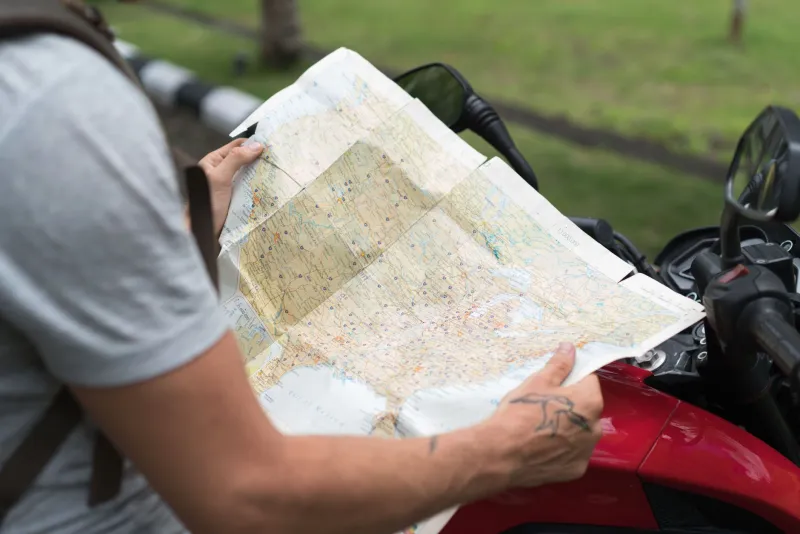
Then there's Derek, a retired teacher from Ohio who spent two weeks driving the rural South with a paper atlas and a rule: no GPS, no booking ahead, no more than a vague sense of direction. He ended up at a fish fry in a church parking lot in Mississippi because a woman at a gas station mentioned it while he was buying a map. He ended up sleeping in a cabin in Alabama because a man at that fish fry had an empty one and offered it. He ended up at a blues festival in a town of three hundred people because the man with the cabin drew him a little map on a paper bag.
"None of that happens with a phone," Derek said. "With a phone, I'm in a bubble. Without it, I'm in the world."
The Anatomy of a Friction Moment
Friction moments are the points where your plan meets reality and reality wins. The GPS dies. The reservation falls through. The road is closed. You arrive after dark and nothing is open. Your bag ends up in Denver when you're in Nashville.
These moments feel terrible in the instant. They feel different in the retelling.
What they have in common is that they force improvisation — and improvisation, in travel, almost always leads somewhere interesting. When the plan is gone, you have to engage. You have to talk to people. You have to make decisions based on what's actually in front of you rather than what an algorithm decided you'd probably like.
You have to be present. And presence, it turns out, is where the good stuff is.
How to Create Friction on Purpose
You don't have to wait for your phone to die. You can build friction into a trip intentionally, and the results are usually worth it.
Arrive without a reservation. Pick a general destination and drive toward it. Stop when something looks interesting. Find a motel by looking for a sign rather than a search result. The motels you find this way are often cheaper, stranger, and more memorable than anything on a booking platform — and the owners tend to be the kind of people who've watched a lot of travelers come through and have opinions.
Leave your phone in the car for the first two hours in a new place. Just walk. Follow what looks interesting. Turn toward noise. Go into shops you wouldn't normally enter. Notice what catches your eye without the mediation of a screen. You'll be surprised what you find when you're not looking for anything specific.
Seek out dead zones deliberately. National forests, rural stretches of state highways, small towns without much infrastructure — these places exist all over the US, and they have something the connected world doesn't: quiet. Real quiet. The kind that makes you realize how loud your ordinary life is.
Book one night, not the whole trip. Having only your first night locked in forces you to make decisions as you go, which is where the interesting choices live. Maybe you stay an extra day somewhere you didn't expect to love. Maybe you leave early from somewhere that didn't click. The trip shapes itself around what you actually experience rather than what you planned to.
Follow the food truck. Or the hand-painted sign. Or the sound of live music. Or the smell of something good. These are the analog algorithms of serendipitous travel — low-tech, high-reward signals that your phone would never surface because they're too local, too temporary, too specific to right now.
What You Find When the Map Runs Out
The places that don't have cell service are often the places that look the way America used to look — and in some cases, still does. Small towns where the diner has been there for fifty years and the owner knows everyone's name. Stretches of highway where the landscape is so big it makes you feel appropriately small. Communities that exist entirely for themselves, not for the tourism economy, and will welcome you warmly if you show up without an agenda.
These places don't trend. They don't go viral. They don't get written up in the listicles that travel algorithms serve you on Sunday evenings when you're daydreaming about your next trip.
They're just there, waiting, behind the last cell tower.
The question is whether you're willing to go that far — to let go of the map, the signal, the reassuring glow of a navigation app — to find out what's on the other side of your own planning.
Jenna, the photographer, put it simply: "The best places I've ever been, I found because something went wrong. I don't think that's a coincidence anymore."
Neither do we.